Safe2Great · The Methodology

From
Safe.
To Great.

The name isn't aspirational. It's sequential. Safety is the floor. Growth is the work. Most organisations plateau between the two and call it success. The Safe2Great methodology was built for what comes after that plateau.

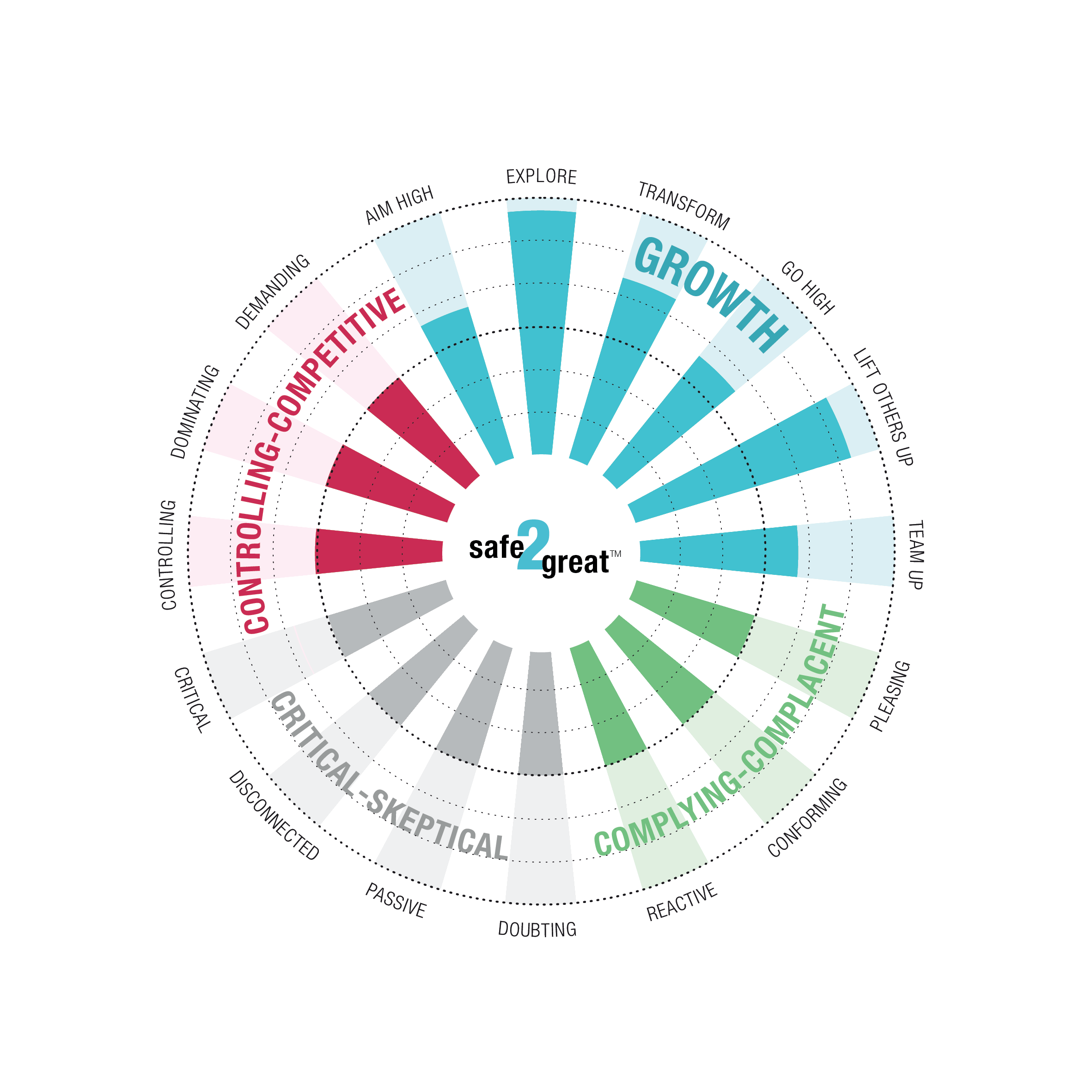
Safe2Great Growth Mindset Compass — the four behavioural profiles

Most organisations aren't failing because they lack strategy.
They're failing because the truth can't get to the top.

The Problem

Most organisations are measuring the wrong thing.

Engagement is not performance

Engagement surveys have been the default organisational diagnostic for two decades. They measure whether people feel good about where they work. They rarely measure whether the organisation is capable of performing at the level it believes it can.

The gap between those two questions is where most leadership and cultural failures live. An organisation can score well on engagement and still be systematically underperforming. It can have high satisfaction scores and a leadership team that is quietly, consistently derailing growth.

"The problem isn't that leaders don't care about culture. The problem is that they're measuring the wrong thing and mistaking good scores for good performance."

The data problem nobody talks about

Traditional 360 tools measure behaviours people can see. They miss the inner game — the mindset patterns driving those behaviours beneath the surface. Leaders can improve their visible behaviours while the underlying patterns that caused the problems in the first place remain completely intact.

Safe2Great measures both. The outer game — what people observe. And the inner game — the thoughts, beliefs, and emotional patterns that determine how a leader behaves when the pressure is actually on. That combination is what makes the data predictive rather than merely descriptive.

Why safety isn't enough

Amy Edmondson's research established psychological safety as the single most consistent predictor of team learning and performance. Google's Project Aristotle confirmed it at scale. The findings are solid. But safety alone is a necessary condition, not a sufficient one. Organisations plateau in what the Safe2Great scale calls the Safe zone — comfortable, not combative, but not growing either.

The methodology was designed for what comes next: moving from Safe to Great. From the absence of threat to the presence of genuine growth. That transition requires something that safety alone doesn't provide — a growth mindset operating at the individual, team, and organisational level simultaneously.

The Scale

Four zones. One honest measure.

The Safe2Great scale applies consistently across every instrument — individual, team, and organisation. The same language. The same framework. No conflicting models to reconcile.

Unsafe
Protective
Safe
Growth
Zone 01
Unsafe

Fear, blame, and systemic self-protection. People are managing their own exposure rather than contributing to collective performance. Leadership behaviour in this zone causes disproportionate organisational damage — often invisibly, until it isn't.

Zone 02
Protective

Not actively dangerous, but not growing. People comply, avoid risk, cover mistakes, and manage relationships carefully. The unspoken contract is comfort over candour. High social cohesion. Low performance ambition.

Zone 03
Safe

Psychological safety is genuinely present. People can speak up, make mistakes without punishment, and collaborate without excessive friction. Necessary — but not sufficient. Many organisations plateau here and mistake safety for growth.

Zone 04
Growth

Safety is the floor, not the ceiling. Challenge, accountability, and continuous development are the operating norms — not periodic initiatives. People stretch, fail productively, and build collective capability over time. This is where high performance actually lives.

The Compass

Four profiles.
One honest mirror.

The Growth Mindset Compass maps behavioural patterns across two axes: Challenge vs Support, and Direct vs Indirect. Every leader has elements of more than one quadrant. The data reveals which patterns dominate — and which ones others experience most.

The uncomfortable truth the Compass surfaces: most leaders think they're operating in the top right. Most of the time, according to the people around them, they're not. The gap between self-perception and impact is where the real development work begins.

"The Compass doesn't tell you who you are. It tells you what you create in other people. That's a fundamentally different and more useful question."

Top Right
Growth
High challenge · High support. The Growth quadrant is where most leaders believe they operate. The data routinely tells a different story.
Top Left
Controlling-Competitive
High challenge · Low support. High drive applied in ways that cap the performance of everyone around them.
Bottom Left
Critical-Skeptical
Low challenge · Low support. Disengaged, cynical, passive. The performance floor — and the cost of bad leadership over time.
Bottom Right
Complying-Complacent
Low challenge · High support. Collaborative, conflict-averse, people-pleasing. Low risk to the social fabric. High risk to performance.
Safe2Great Growth Mindset Compass

Growth Mindset Compass™ — Safe2Great

The Profiles

The pattern you create
in other people.

Most leaders have elements of more than one profile. The point is not to label — it's to make visible what is usually invisible. The profile that shows up in your data is the one the people around you are experiencing.

Profile 01 · Growth Quadrant
Growth

Builds on strengths, actively seeks feedback, enables others to perform at their best. High on both challenge and support — genuinely holds people accountable while creating the conditions for them to succeed. Drives their own development and models the learning behaviour they expect from their team.

Explore Transform Go High Lift Others Team Up Aim High
Take the self test →
Profile 02 · Top Left Quadrant
Controlling-Competitive

Controlling and competitive. Believes their ideas are superior and prefers doing things their own way. Dominates rather than collaborates. Finds it hard to follow rather than lead. High drive and standards — applied in ways that systematically cap the performance of everyone around them. Often the last to know that's what they're doing.

Demanding Dominating Controlling Conflict Competition
Take the self test →
Profile 03 · Bottom Right Quadrant
Complying-Complacent

Compliant and complacent. Prioritises relationship maintenance over honest performance. Avoids necessary conflict, withholds negative feedback, covers mistakes, follows rules without questioning. Low risk to the organisation's social fabric. High risk to its performance — because the honest information that could improve things never reaches the surface.

Pleasing Conforming Reactive Complacency Cover-up
Take the self test →
Profile 04 · Bottom Left Quadrant
Critical-Skeptical

Disengaged, doubtful, and disconnected. Cynical about change, passive in contribution, prone to contempt. Often the result of prolonged exposure to poor leadership — the Critical-Skeptical profile is what happens when someone has been in the Controlling or Unsafe zone long enough to stop believing improvement is possible. The performance floor.

Critical Disconnected Passive Doubting Cynicism
Take the self test →

Culture is a leadership behaviour problem.
Which means it's also a leadership behaviour solution.

The Research

Built on
solid foundations.

The Safe2Great model integrates 30 years of validated research. Not a proprietary theory built to be sold — a practical framework built to be used.

Psychological Safety — Amy Edmondson, Harvard

Edmondson's research identified psychological safety as the single most consistent predictor of team learning and performance. Safe2Great operationalises it — not as a cultural aspiration, but as a measurable, behaviourally defined state that can be tracked, developed, and held accountable.

The key insight her research unlocks: psychological safety is not about being nice, conflict-free, or comfortable. It's about whether people believe they can take interpersonal risks without fear of punishment or humiliation. That belief is shaped almost entirely by leadership behaviour.

Growth Mindset — Carol Dweck, Stanford

Dweck's research identified that the single biggest predictor of an individual's capacity to learn, adapt, and develop is their belief about whether their own abilities are fixed or growable. Leaders with a growth mindset build organisations that learn. Leaders with a fixed mindset — regardless of their intelligence or track record — systematically cap the potential of everyone around them.

Project Aristotle — Google

Google's five-year study of team effectiveness across hundreds of teams confirmed psychological safety as the dominant factor in team performance — more than technical skill, seniority, or any other variable. The Great Teams Assessment is built directly on those findings, translated into a real-time measurement instrument.

Microsoft's Cultural Transformation

When Satya Nadella made growth mindset the foundation of Microsoft's cultural transformation, the results were not subtle. Safe2Great was inspired in part by that case — and built to translate those principles into measurable behaviours that can be assessed, developed, and benchmarked across organisations of any size.

"People with higher levels of personal and interpersonal psychological safety are more robust, more resourceful, and more effective. That's not a hypothesis. It's what the data shows across thousands of leaders."
Amy Edmondson · Harvard Business School
Psychological Safety

The belief that one can speak up, take risks, and challenge ideas without fear of punishment. The single most consistent predictor of team learning and performance across Edmondson's decades of research.

Carol Dweck · Stanford University
Growth Mindset

The belief that abilities can be developed through dedication and hard work. The fundamental predictor of whether individuals — and the organisations they lead — are capable of sustained learning and adaptation.

Google · Project Aristotle
Team Effectiveness

Five years. Hundreds of teams. One dominant finding: psychological safety is the foundation of team performance. Technical skill, seniority, and personality all mattered less than whether people felt safe to contribute.

The Process

How transformation
actually happens.

The Safe2Great development process is not a series of workshops. It is a structured journey from honest assessment to lasting behavioural change — with measurable progress at each stage.

Stage 01 · Assessment
See what's actually there

Start with data, not assumptions. The right instrument establishes an honest baseline. This is the stage most organisations skip — and the one that makes every subsequent intervention more accurate and effective.

Stage 02 · Awareness
Make the invisible visible

Assessment data is only useful if it creates genuine insight. Skilled debrief and facilitation helps leaders and teams see their patterns clearly — including the ones they've been successfully avoiding.

Stage 03 · Development
Build a specific agenda

Generalised leadership development doesn't change specific behaviours. The Safe2Great development agenda is built from actual data — targeting the precise mindset patterns and behavioural habits that are limiting performance.

Stage 04 · Transformation
Embed under real pressure

Insight without embedding is just interesting. The final stage converts development agenda into durable new habits — the kind that hold when the pressure is on, not just in the workshop room.

For Organisations

Start with an honest assessment.
Not a workshop.

If you want to understand what's actually driving your culture, the answer is in the data. Safe2Great works directly with leadership teams and boards who are ready to look below the surface.

Talk to Skip → See the Tools →
For Practitioners

Deliver methodology that actually measures change.

Accreditation gives you the full Safe2Great instrument suite, global benchmark access, and a development system you can build a practice around. For coaches, OD practitioners, and HR leaders who are done with generic content.

Apply for Accreditation →