Growth
Mindset
Compass
Leadership 360
Culture for Growth
Self Test
Great Teams

One system.
Every level of the organisation.

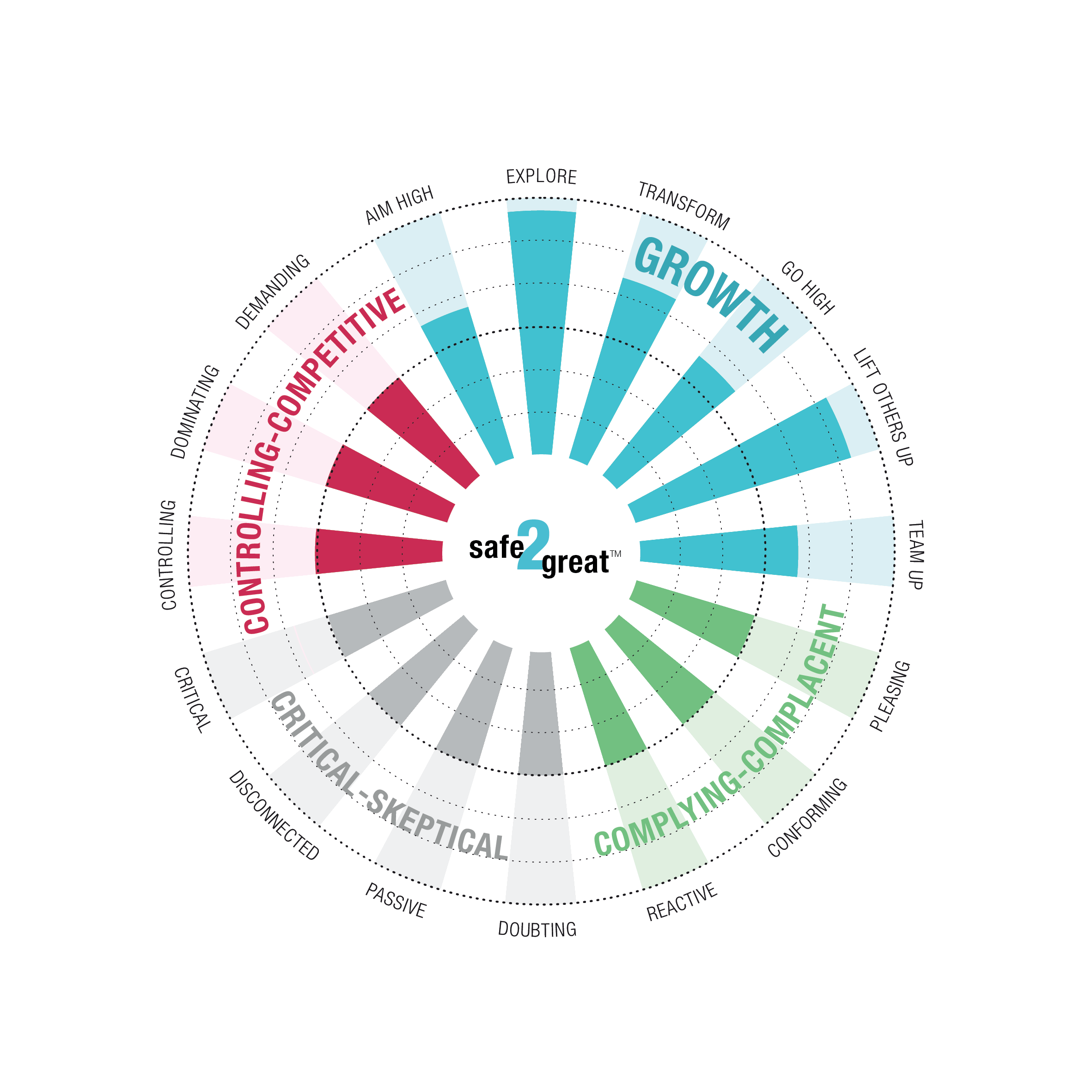
The Growth Mindset Compass is what makes Safe2Great different from a collection of separate assessments. Every instrument uses the same framework, the same visual language, and the same Protective–Growth scale.

That means a leader's 360 result connects directly to their team's dynamics, which connects to the organisation's culture data. You're not combining different consultants' outputs. You're reading the same instrument at different depths.

No need to learn four separate models. No conflicting vocabularies. One compass. Every level.

Instrument 01 · Leadership

Growth Mindset
Leadership 360

Multi-rater · Global Benchmark · 10+ Languages
ProtectiveGrowth
Scale
Unsafe
Growth
FormatMulti-rater (self + peers + direct reports + manager)
BenchmarkGlobal database — thousands of leaders
Languages10+ with English report
DeliveryAccredited practitioner required
OutputIndividual development report + debrief
Talk to Skip → Download Brief →

What it measures

The Growth Mindset Leadership 360 is a full multi-rater assessment designed for the realities of 21st-century leadership — where creativity, collaboration, and adaptability matter more than command authority, and where digitalization is disrupting nearly every role.

Inspired by the work on Growth Mindset at Microsoft, this instrument measures both the inner game — what a leader thinks, feels, and believes about themselves — and the outer game — the behavioural impact they actually have on others. The gap between the two is usually where the problem lives.

"Most leaders believe they are developing their people. Most of their people believe the opposite. The 360 makes that gap visible — and measurable."

What it measures

Challenge vs. support balance
Conflict management style
Psychological safety creation
Growth mindset behaviours
Interpersonal effectiveness
Leadership derailment risk
Blind spots under pressure
Team culture contribution

Who it's for

Leaders at any level who are serious about understanding what their people actually experience — not what the last performance review said. Particularly valuable for leaders in high-growth, high-pressure, or post-merger environments where culture is changing faster than awareness.

Also used as the entry point for broader leadership development programmes — establishing an honest baseline before coaching or team intervention begins.

How it connects

The 360 result maps directly onto the Growth Mindset Compass used across all Safe2Great instruments. A leader's individual score sits in the same framework as their team's Great Teams result and their organisation's Culture for Growth data — creating a coherent picture across all three levels without combining different models.

Most leaders know something isn't working.
They just don't know what — or how deep it goes.

Instrument 02 · Individual

Growth Mindset
Self Test

Self-Assessment · Blind Spots · Development Agenda
ProtectiveGrowth
FormatIndividual self-assessment
FocusInner game — mindset, habits, decision-making
OutputPersonal development report + coaching agenda
DeliveryStandalone or combined with 360
SupportCertified Growth Mindset coach recommended
Talk to Skip → Download Brief →

What it measures

The Growth Mindset Self Test focuses entirely on the individual's inner world — the mindset patterns, emotional defaults, and behavioural habits that determine how a person actually operates under pressure. Not the polished version. The real one.

Where the Leadership 360 shows how others experience you, the Self Test shows you what's driving those behaviours from the inside. Used together, they close the loop between intention and impact.

"The Self Test is the instrument most leaders resist — and the one that creates the most significant shifts."

What it reveals

Mindset patterns under pressure
Identified strengths and blind spots
Habitual decision-making defaults
Counterproductive behaviours
Growth vs. fixed mindset markers
Personal psychological safety
Resilience and resourcefulness
Coaching and development priorities

Who it's for

Leaders who want an honest starting point before committing to a development programme. Executives preparing for a step-change in role or responsibility. Coaches who want to ground their engagement in real data rather than self-reported narratives.

Also used as a standalone instrument for high-potential programmes, where understanding individual mindset patterns is the foundation for everything else.

The output

The Self Test produces a personal development report that identifies strengths, blind spots, and counterproductive patterns — and translates these into a specific, actionable change agenda. Combined with coaching from a certified practitioner, this becomes a sustained habit-change programme rather than a one-off assessment.

Instrument 03 · Teams

Great Teams
Assessment

Real-Time · Workshop-Ready · Protective–Growth Scale
ProtectiveGrowth
FormatTeam survey — real-time feedback
ScaleProtective–Growth (Google research foundation)
Ideal forWorkshops, offsites, and team sprints
TimelineResults same day — not weeks later
DeliveryAccredited Safe2Great practitioner
Talk to Skip → Download Brief →

What it measures

The Great Teams Assessment (GTA) was built on a core insight from Google's Project Aristotle: psychological safety is the single most important factor in high-performing teams. Not talent. Not resources. Not leadership charisma. Safety.

The GTA measures team dynamics on the Protective–Growth scale — mapping where the team sits between self-protection and genuine collective growth. The results are immediate, specific, and actionable.

"You can have the best people in the world in a room. If the team dynamic is wrong, they'll underperform. The GTA shows you exactly what's wrong — and what to do first."

Team dimensions assessed

Commitment and accountability
Psychological safety levels
Conflict management patterns
Decision-making effectiveness
Innovation and risk tolerance
Performance management norms
Connectedness and trust
Adaptability under pressure

Designed for real-time work

Most team assessments produce a report two weeks after the team has already moved on. The GTA is designed to run live — in a workshop, offsite, or sprint — with results available in the room on the same day. The team reflects on its own data in real time, which is where the real shift happens.

Who it's for

Leadership teams navigating change, conflict, or underperformance. Project teams under pressure. Any team where the collective dynamic is limiting individual contribution. Also used as a diagnostic before broader organisational culture work — because culture lives in teams before it lives in data.

Culture doesn't live in the strategy deck.
It lives in what people actually do when no one important is watching.

Instrument 04 · Organisation

Culture for Growth
Survey

Stratified Sampling · Unsafe–Safe–Growth · Predictive
UnsafeGrowth
ParticipationOnly 30–40% required (stratified sampling)
ScaleUnsafe–Safe–Growth
OutputCulture map + predictive insights + priority areas
IdentifiesHealthy behaviours AND toxic/unethical practices
DeliveryAccredited Safe2Great practitioner
Talk to Skip → Download Brief →

What it measures

The Culture for Growth survey (C4G) maps the actual culture of an organisation — not the culture leadership believes exists, and not the culture the last engagement survey reported. The one that shows up in how people behave when results are under pressure.

Most engagement surveys measure sentiment. The C4G measures behaviour — and behaviour predicts performance. It assesses organisational interactions on a three-point scale: Unsafe, Safe, and Growth. The difference matters. An organisation can be psychologically safe and still not be growing.

"The answer is never the strategy. It's never the market. It's almost always culture. And culture is almost always measurable — if you're asking the right questions."

What makes it different

Stratified sampling — 30–40% is enough
Identifies toxic practices, not just weak scores
Predictive — links to effectiveness and leadership quality
Readiness for change assessment
Business unit level breakdown
Shared cultural goals across teams
Accountability framework built in
Tracks change over time

What you can do with it

The C4G gives leadership a scientifically grounded map of where their culture actually is — and a clear view of where the gaps, risks, and development priorities sit. It's not a report that goes in a drawer. It's a starting point for a structured culture development programme.

Because it uses stratified sampling rather than whole-organisation surveys, it can be deployed faster, repeated more frequently, and compared across business units or geographies without survey fatigue.

Who it's for

Boards and leadership teams who need to know what their culture is actually doing to performance. HR directors who want something more rigorous than an engagement score. Organisations post-merger, post-crisis, or preparing for significant change — where understanding the cultural baseline isn't optional.

The system is the point.

Four instruments designed to work independently or as an integrated development system across every level of the organisation. The same framework. The same language. No need to reconcile different models.

Entry point 01
Start with the leader
Begin with the Leadership 360 or Self Test to establish an honest individual baseline. Most cultural problems have a leadership origin. This is where you find it.
Entry point 02
Start with the team
The Great Teams Assessment can be deployed quickly in a workshop or sprint. Ideal when team dynamics are the presenting issue and you need results in the room the same day.
Entry point 03
Start with the culture
The Culture for Growth Survey provides the organisational view. Use it to identify where the systemic risks are before deciding which leadership or team interventions to prioritise.
"People with higher levels of personal and interpersonal psychological safety
are more robust, more resourceful, and more effective."
— Safe2Great research foundation
For Organisations

Your culture is a leadership problem.
Let's measure it.

Safe2Great works directly with leadership teams, HR directors, and boards who need to know what's actually driving their culture — not what the engagement survey reports.

Talk to Skip →
For Consultants & Coaches

Add real measurement
to your practice.

Accreditation gives you four validated instruments, access to global benchmarks, and a methodology that tells clients what they need to hear — not what they want to.

Apply for Accreditation →