Growth Mindset & Psychological Safety · The integrated system

Growth mindset and psychological safety assessments. One integrated system.

Six validated growth mindset assessment tools measuring psychological safety and behaviour at every level of an organisation — individual, leadership 360, team assessment, culture survey, and change-programme diagnostic. Each tool is its own product. Together they form one integrated developmental system, anchored in a single underlying model: the Growth Mindset Compass.

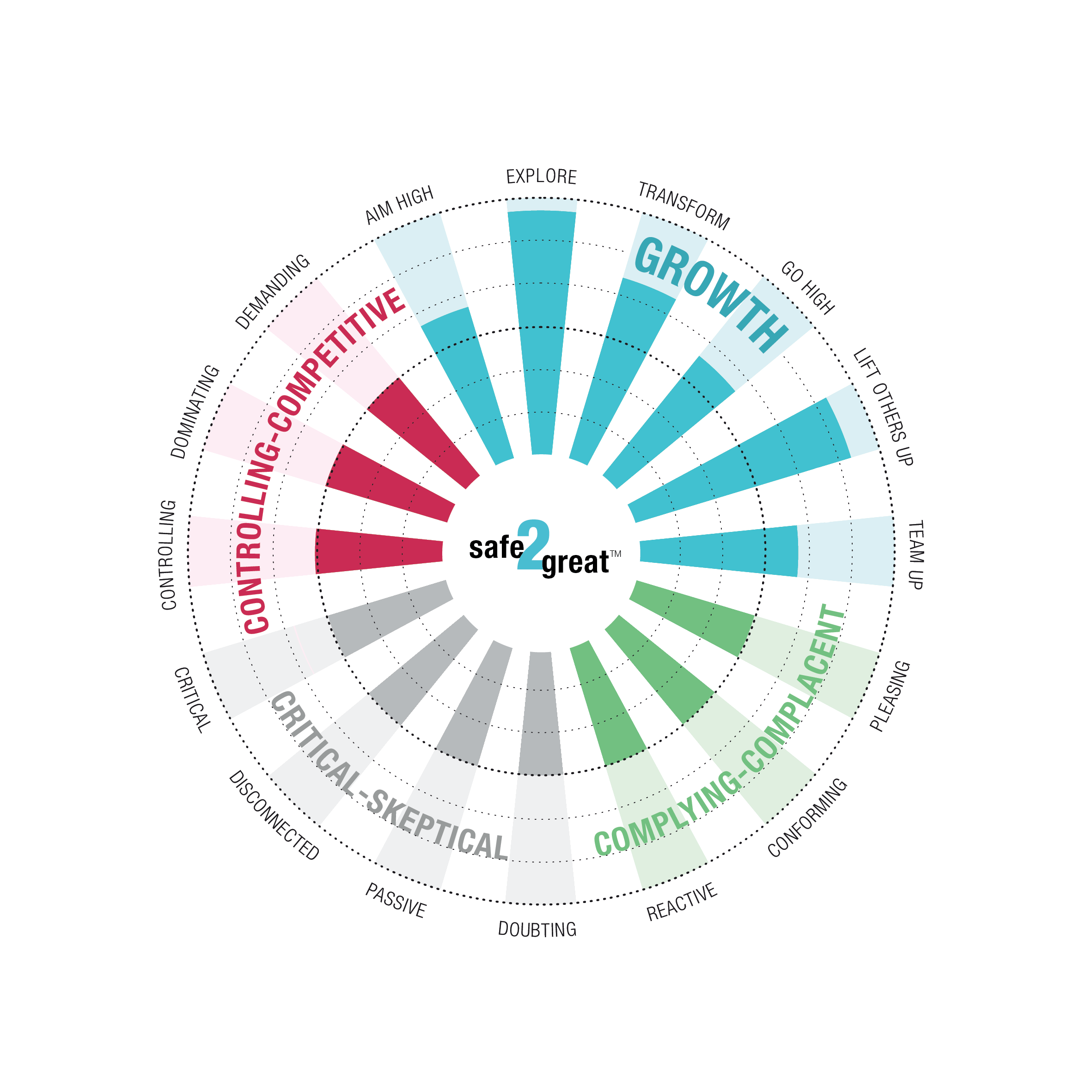
The Growth Mindset Compass — showing the four operating zones (Growth, Controlling-Competitive, Critical-Skeptical, Complying-Complacent) with their behavioural modes. Every Safe2Great instrument measures against this same model.
The Growth Mindset Compass · One model, six instruments, three scales

"Tools are not the work — but they make the development work targeted, trackable, and teachable."

Skip Bowman · Safe2Great
Fathom 01 · The underlying frame

Two operating systems. One of them is learning.

Every Safe2Great instrument measures the same fundamental contrast — and reports where, specifically, a leader, team, or organisation currently sits on it. The framework is simple enough to remember. The measurement is rigorous enough to stand up.

Protective Mindset

Driven by fears.

  • Avoids failure and errors
  • Protects and defends what has already been achieved
  • Relationships protect or restrict
  • Treats challenge as threat

"Failure is the limit of my ability. I stick to what I know. When I'm frustrated, I give up."

Growth Mindset

Driven by vision and values.

  • Uses failure to learn
  • Willing to take risks to learn and develop
  • Relationships improve resilience and impact
  • Treats challenge as information

"Challenge helps me improve. I like to try new things. Feedback is constructive."

Fathom 02 · The integration

One model. Three organisational scales.

The same Growth Mindset Compass runs across every level of the organisation. A result at the individual level connects directly to a result at the team and organisational level — because they're all measured against the same underlying model. That's the piece most leadership-development tools don't have.

The Safe2Great system — one compass, three scales The same Growth Mindset Compass applied at three scales: Leaders, Teams, and Organisation. Each scale has its own validated instruments. LEADERS Individual GML360 · GMPL360 · Self Test TEAMS Collective Great Teams Assessment ORGANISATION System Culture for Growth · Change Champion ONE MODEL · THREE SCALES · SIX INSTRUMENTS
Every result at one scale connects directly to results at another — because they are measured against the same underlying Growth Mindset Compass.
Fathom 03 · Six instruments

What each instrument actually measures.

Each instrument can be used standalone or as part of a development programme. All built on the same Growth Mindset Compass. All benchmarked against a global dataset. Delivered exclusively by accredited practitioners.

01
Individual Leader
Multi-rater 360°
Standalone · Programme entry point · Benchmarked

Growth Mindset Leadership 360

A multi-rater leadership 360 designed to measure behaviour under pressure — what leaders actually do when something goes wrong, not what they say they do in calm conditions. Captures both growth behaviours and protective patterns in the same frame, and correlates both against outcome measures rated by the same people.

What it measures
  • Balance of challenge and support the leader creates for their team
  • Mental safety level — how much thinking is self-handicapping versus self-actualising
  • Conflict management style under pressure
  • Ability to manage performance and change
  • Relationship quality with peers, direct reports, and the manager
  • Leadership effectiveness benchmarked against a global sample of 1,012+ leaders
How it's used

Standalone as a diagnostic for senior-leader development. Embedded inside the Executive Team Transformation and Leadership Pipeline Development programmes. Every Safe2Great coaching engagement begins with a GML360 debrief.

The empirical backbone of the Safe2Great research programme.

02
Project Leader
Multi-rater 360°
Standalone · Baked into two skills packages

Growth Mindset Project Leadership 360

Cutting-edge projects are run by experienced teams for a specific reason: if the outcome could be predicted, the project wouldn't need one. Surprises aren't failures on that kind of work — they're the point. Innovation is the deliverable. Trying things that haven't been done before is the job. The plan is provisional by design, and adjustment as evidence arrives isn't slippage — it's the method.

This was once confined to R&D labs and bounded incubation projects. It's now how an increasing share of serious organisational work actually runs — digital transformation, AI implementation, product development, customer co-creation, sustainability transitions. Most "projects" inside ambitious organisations today are discovery work dressed in project clothes. And the leadership behaviours that carry this work are genuinely different from the ones that carry predictable delivery.

The GMPL360 is built for that shape of leadership — measuring whether a project leader can actually run work where the point is to not know yet, and hold a stakeholder mix (which often includes customers) while genuine discovery happens in real time.

The failure mode it's designed to surface

On innovation projects, the common failure isn't cost overrun. It's innovation theatre — a project that was supposed to discover something new ends up delivering a predictable outcome dressed up as innovation, because the leader couldn't hold uncertainty in front of stakeholders long enough for genuine discovery to happen. Signals of this pattern: the team stops surfacing genuinely novel findings because the leader needs a coherent narrative for the next review. Customer feedback that contradicts the original hypothesis gets rationalised away. "Let's de-risk this" becomes a euphemism for scaling the ambition down. Legitimate pivots get politicised because they look like failure to a stakeholder audience trained on traditional project management.

The behavioural pattern underneath is almost always the same — the leader's tolerance for "I don't know yet" collapses under external pressure, and the team starts reverse-engineering confident-sounding answers rather than doing the discovery work they were hired for.

The six growth operating modes — for discovery work
  • Aim High — holding the ambition of genuine discovery when it would be easier to scale back to the predictable
  • Explore — the central growth behaviour for innovation work: actively seeking surprise, rather than avoiding it
  • Transform — willingness to pivot when the evidence demands it, in front of stakeholders, without treating the pivot as failure
  • Go High — leading with purpose and intellectual honesty rather than stakeholder theatre
  • Lift Others Up — developing the team's own discovery capability, not just extracting output
  • Team Up — collaborating across functions and with external stakeholders, including customers as genuine partners rather than audiences
Plus the three protective mindsets, made specific to innovation work
  • Controlling-Competitive — premature certainty; faking confidence to stakeholders; shutting down team exploration to maintain a clean narrative; refusing to change direction when evidence demands it
  • Complying-Complacent — delivering predictability and calling it innovation; absorbing scope shifts silently rather than renegotiating; saying what stakeholders want to hear rather than what the evidence shows
  • Critical-Skeptical — disengagement from customer feedback that contradicts the original hypothesis; cynicism about the possibility of real discovery; withdrawing emotionally at the moment the team needs a leader who can hold uncertainty
Why it's distinctive

Most "project leadership" development focuses on methodology — Agile, waterfall, scaled frameworks, stage-gate governance. These matter, but they can't by themselves produce the behaviours that cutting-edge projects need. A leader who is brilliant with methodology but incapable of holding genuine uncertainty will still produce innovation theatre. The GMPL360 works on the layer underneath: the psychology of leading work where the point is discovery.

How it's used

Feedback is gathered from the project team, peers, sponsors, and (where appropriate) external stakeholders, then organised onto the Growth Mindset Compass. The report shows the leader's current levels of Growth Mindset and the three protective mindsets, broken down into the specific behaviours that make or break innovation projects. The development path out of a controlling pattern is not the same as the path out of a conforming one — the Compass makes the difference visible and actionable.

Baked into the Influence with Impact and Praise with Purpose skills packages as pre/post behavioural measurement across a cohort. Available standalone for organisations running innovation-heavy project portfolios, transformation programmes, or customer co-creation work — and for PMOs that have realised methodology training alone doesn't produce the leaders their hardest projects need.
03
Individual
Self-assessment
Standalone · Any level · Coaching anchor

Growth Mindset Self Test

An individual mindset self-assessment that maps the inner game — a person's default behavioural patterns, protective armour, and growth-oriented tendencies. Available for any level of the organisation, not just leaders.

Where the GML360 asks "what do others experience of you?", the Self Test asks "what's your own honest starting point?". It's the fastest way for an individual to locate themselves on the Growth Mindset Compass — and for a coach, it's the diagnostic anchor for an individual development conversation.

What it measures
  • Dominant patterns across the four compass zones
  • Strengths, blind spots, and habitual protective responses
  • Strategies for breaking unhelpful habits and amplifying growth-oriented ones
  • Suggested mindset shifts to turn insight into change
How it's used

Standalone for self-directed learning. Often used as the first instrument in a coaching relationship, with the GML360 following once the coaching is underway. Also available as an enterprise-level screen across a whole workforce — particularly useful when an organisation wants to understand distribution of growth and protective patterns before committing to a leadership programme.

04
Team
Collective diagnostic
Standalone · Workshop-ready · Hybrid & remote

Great Teams Assessment

A team-level diagnostic that combines the Growth Mindset Compass with the eight characteristics of high-performing teams — building on the same body of research that informed Google's Project Aristotle findings.

Designed for speed. Results ready in hours, not months. Works for co-located, hybrid, and fully remote teams — which matters for any 2026 organisation where the team no longer shares a physical space.

The eight characteristics measured
  • Psychological safety — can members speak up, take risks, learn from failure
  • Vision — clarity and alignment around a shared goal
  • Positivity — grit, mutual support, willingness to embrace risk
  • Creativity and innovation — ability to generate and implement fresh ideas
  • Embracing challenges — adaptability in changing circumstances
  • Commitment — reliability, dedication, shared accountability
  • Transparent communication — how information, feedback, and challenge flow
  • Overall team effectiveness — how the collective actually performs
How it's used

Standalone as a team-development diagnostic or workshop input. Embedded inside the Team Intervention Sprints as the opening measurement. Results cleanly onto the same Compass as the individual-level GML360, so a team leader can see their own 360 profile mapped against their team's collective profile on the same underlying axes.

05
Organisation
Culture survey
Standalone · 30–40% response needed · Stratified sampling

Culture for Growth Survey

An organisational culture mapping instrument that locates healthy and toxic patterns across business units, functions, and regions — using stratified sampling, so a 30–40% response rate gives you a statistically valid read rather than requiring the unrealistic 70%+ response rate of traditional engagement surveys.

Maps interactions on the Unsafe–Safe–Growth scale, giving the organisation a systematic way to see where the culture is currently producing engagement, where it's producing compliance, and where it's actively blocking growth. Provides predictive insights into effectiveness, leadership quality, responsiveness, and readiness for change.

What you learn
  • Current distribution of growth and protective patterns across the whole organisation
  • Cultural variation by business unit, function, geography, or demographic cut
  • The specific behaviours — not the abstract values — that define the lived culture
  • Where toxic patterns are hiding, and what to address first
  • A behavioural baseline to measure future culture change against
How it's used

Standalone as a culture diagnostic for boards, HR functions, or executive teams setting the direction for transformation work. The opening measurement in any Enterprise Culture Transformation programme. Also the culture layer inside the Change Champion Survey below.

Used at Danfoss Northern Europe to track a +12-point rise in Aim High and a −12-point drop in Conforming across 174 respondents over 12 months. See the Danfoss case study.

06
Change programme
Readiness & culture
Standalone · Programme backbone · Pre/post

Change Champion Survey

Most change projects fail, deliver late, or miss expectations — and most pre-change audits miss why. The Change Champion Survey looks below the surface of the change team's strategy and measures the organisational culture that will either carry the change or strangle it.

Combines a change-readiness diagnostic with an organisational culture scan and a leadership-capability assessment — so the organisation sees the change, the culture, and the leadership all in one measurement.

What it measures — the four Cs
  • Compelling — how strongly the change narrative resonates with the team
  • Courageous — whether the organisation has the commitment to try new things
  • Capable — whether competence and capability gaps are being addressed
  • Contagious — whether the change is spreading through social and behavioural influence, or being blocked
Plus three further layers
  • Organisational culture scan — is the culture controlling-competitive, conforming-complacent, or critical-skeptical in ways that will block the change?
  • Change leadership outcomes — involvement, agility, responsiveness to feedback, trust
  • Personal change capability — each respondent's own commitment, confidence, and capability to deliver on the project goals
What makes it distinctive

The survey measures derailers as well as enablers — the "diseases" (politics, resistance, skepticism, complacency) alongside the positive contributors. Most change surveys measure only what people say they support. This one measures what's actually blocking.

How it's used

Standalone as a readiness diagnostic before a change project launches. The backbone measurement of the Change Champion programme, which builds on its findings with the five-module Confronting for Change package plus change-communication and change-leadership development.

Every Safe2Great instrument complies with European GDPR regulations and adheres to the Danish Psychological Association standards for the safe and responsible use of psychometric tools. Available in 10+ languages, delivered exclusively by accredited practitioners.

Fathom 04 · The integrated system

Six instruments, one system. Four ways in.

Each instrument is a standalone product. They also sit inside a broader developmental system — programmes, research, internal capability, practitioners — that turns measurement into durable change.

Ready to measure what's actually happening.

Whether you want to assess one leader, one team, a change programme, or a whole organisation — the starting point is a short conversation about what you're actually trying to understand.

Talk to Skip → Become accredited →